
Mr. President, Excellencies, distinguished delegates,
Nearly four years into Russia’s full-scale invasion of Ukraine, the plight of civilians has become even more unbearable.
This is confirmed by my Office’s latest report covering the period from 1 June to 30 November this year. As peace negotiations continue, our monitoring and reporting show that the war is intensifying, causing more death, damage, and destruction.
Over the past four years, my staff have undertaken more than 1,150 missions to areas affected by the war and conducted more than 11,100 interviews about alleged violations of international human rights and humanitarian law.
The picture that emerges is very disturbing.
Civilian casualties so far this year are 24 per cent higher than the same period last year, largely due to the Russian armed forces stepping up their use of long-range missiles and drones in frontline and urban areas. This escalation is a never-ending nightmare for the people of Ukraine.
Attacks are occurring nationwide, including places in the west far from the frontline which previously were untouched by the fighting. Between December 2024 and November 2025, there was a significant increase in the average daily number of long-range drones deployed by the Russian Federation. No part of the country is safe.
In one example, on 19 November 2025, the Russian Federation launched some 500 drones and missiles across Ukraine. A cruise missile struck a residential building in Ternopil, and a drone ignited a fire in another, together killing at least 38 civilians and injuring 99, with some civilians still missing. This was the deadliest attack in western Ukraine since the start of the war.
Throughout the year, the vast majority of civilians killed and injured were in territory controlled by Ukraine, and more than 60 percent were near the frontline.
The Russian Federation reports that 146 civilians were killed and more than 1,150 injured on its territory during the reporting period, but we have not been able to verify these figures.
Attacks on energy infrastructure persist across Ukraine, leaving people without heating, water, and public transport for extended periods of time. In October and November, the Russian Federation launched eight large-scale coordinated attacks, causing prolonged emergency outages in some areas, and forcing scheduled power cuts across most regions for up to 18 hours a day.
Winter is closing in — turning every power outage into a cold, frightening ordeal for families, older people, and people with disabilities.
I would like to shine a light on the anguish of civilians in frontline communities, as Russian armed forces press forward.
The use by Russian forces of short-range drones equipped with first-person view cameras is causing significant civilian harm. They have struck people on bicycles, in cars, and on public buses, killing some 300 civilians during the reporting period.
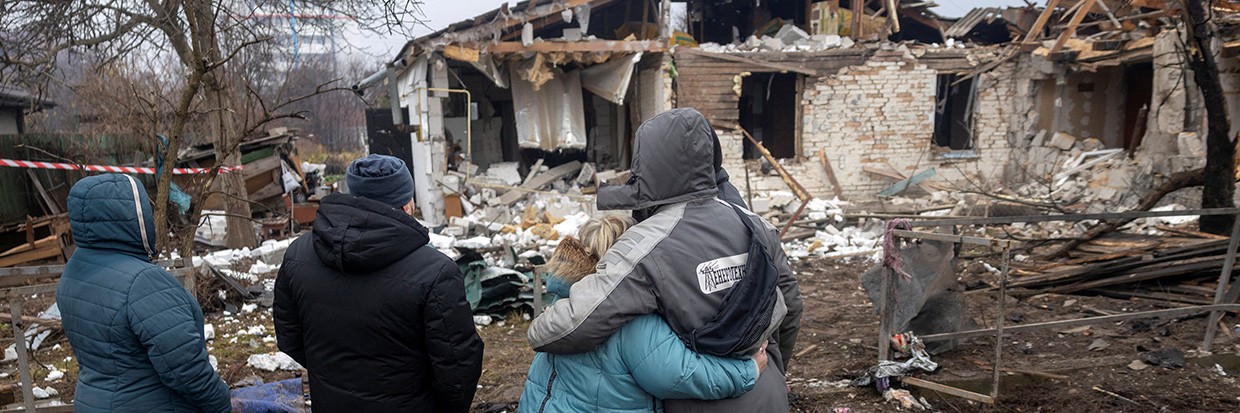
Aerial bombs and other munitions have damaged or destroyed residential buildings, hospitals, and schools, and triggered more displacement. The hostilities are preventing ambulances from reaching people in need in some frontline regions, and aid workers are risking their lives to help.
While many people have been evacuated from frontline cities and villages, some have been unable to leave. These are mainly older people and people with disabilities, whose evacuation is difficult because many transit centres lack appropriate facilities and there is a severe shortage of suitable housing.
Nearly half of the people killed in frontline areas are over 60 years old.
Once again, the most vulnerable - including those who find it difficult or impossible to move from their homes - are bearing the brunt of war.
Most food shops, pharmacies, and health clinics in frontline areas, including parts of Donetsk, Kharkiv, Kherson, and Sumy regions have shut down. Some frontline communities have not had electricity for more than two years.
Residents in some areas of occupied Donetsk reported receiving running water of very poor quality once every three days or less. This is particularly worrying in a region with abandoned mines and chemical plants.
Mr. President,
The fate of Ukrainian prisoners of war and civilian detainees remains dire.
Since the start of the full-scale invasion, my Office has documented the extrajudicial execution of 96 Ukrainian prisoners of war and people hors de combat.
Since mid-November, we have recorded an increase in reports of executions of Ukrainian service personnel. We assessed as credible the reported killing of 14 Ukrainian prisoners of war after capture by Russian forces, and we are looking into 10 other cases.
My team also recorded four executions of Russian prisoners of war by Ukrainian armed forces, and we are reviewing credible allegations of three additional incidents.
We continue to document systematic and widespread torture and ill-treatment of Ukrainian prisoners of war in detention. Since 1 June 2025, my team has interviewed 187 Ukrainian prisoners of war after they were released. 185 of them provided detailed accounts of torture and ill-treatment; most of them reported being subjected to sexual violence.
We also interviewed 127 Russian prisoners of war and 10 nationals from third countries held by Ukraine. Half of them described torture and ill-treatment in transit places before arrival at official places of detention.
Meanwhile, people displaced across Ukraine are struggling to find jobs and long-term housing, leading some to return to their homes in unsafe areas.
In Russian-occupied territories, our findings include tightening restrictions on freedom of movement, expression, and religion. Internet and messenger services have been further limited.
There are growing concerns about property confiscation by the Russian authorities in occupied territory, in violation of international humanitarian law. As of November 2025, more than 38,000 homes had been registered as potentially abandoned in occupied regions. Ukrainians reported being unable to verify the status and retain ownership of their private property, due to procedural obstacles.
International media coverage focuses mostly on high-profile peace efforts these days, whereas the daily suffering of the people across the country fades away.
Yet, the situation of Ukrainian civilians has deteriorated even further.
I again call on the Russian Federation to stop the war, to respect international law and to protect civilians. I urge it to halt all extrajudicial executions, torture, ill-treatment, and sexual violence against prisoners of war and civilian detainees, and to respect and protect human rights in occupied territory.
I urge Ukraine to safeguard prisoners of war from torture and ill-treatment.
Perpetrators of all human rights and humanitarian law violations must be held accountable.
I cannot even fathom the exhaustion of the people of Ukraine.
They need the silencing of the guns. They need peace, in line with the United Nations Charter, international law, and General Assembly resolutions, anchored in human rights.
As part of any negotiation for a ceasefire and sustainable peace, I encourage confidence-building measures that can reduce harm and build trust over the longer term.
For example, as immediate measures, this would include commitments not to use long-range weapons and short-range drones in densely populated areas, and not to target critical energy infrastructure, such as electricity and heating.
They would include commitments to exchange all prisoners of war and to release and return home all Ukrainian civilian detainees.
These are just some of the measures that could be taken, and my Office is ready to support these efforts.
Thank you.